
Is a Master’s in Sustainability at Oxford University worth it?
Table of contents
Introduction
Have you ever wondered if a single year at one of the world’s most prestigious institutions could truly pivot your career toward the global net-zero transition?
In a world increasingly defined by climate risk and the race to Net Zero, the question isn’t whether sustainability is important- it’s whether a specific degree can actually help you lead it. Since you clicked on this blog, you might be checking out Oxford’s Sustainability program and wondering if the Master’s in Sustainability at Oxford University is worth it. Does it justify the investment?
At Edyou Abroad, we have seen professionals navigate these exact crossroads. I’ve broken down the data, the curriculum, and the career ROI to help you decide if this path aligns with your future.
Oxford Sustainability Enterprise and the environment: an Overview
The Oxford Sustainability Department (housed within the School of Geography and the Environment) doesn't just teach environmentalism; it teaches the intersection of climate science, finance, and corporate strategy.
|
Program |
MSc in Sustainability Enterprise and the Environment |
|
Duration |
12 months |
|
Tuition fees |
£48,820(international students) |
|
Core focus |
Challenges of climate change and sustainable development by transitioning global economic and financial systems to a net-zero, sustainable future |
|
Application Deadlines |
Intake for 2026 is over. For 2027, you can expect deadlines from November to February |
|
Location |
London, United Kingdoms |
This is a 12-month, intensive journey designed for those who want to lead. Whether you are an early-career professional or a seasoned expert looking to pivot, the Oxford Sustainability Enterprise and the Environment degree equips you with the "hard" analytical skills and "soft" leadership finesse required to navigate complex global systems.
Curriculum Structure
The flagship program of the University of Oxford in this field is the MSc in Sustainability, Enterprise and the Environment, hosted by the renowned Smith School of Enterprise and the Environment. Unlike traditional environmental degrees that might focus purely on ecology, this program views the climate crisis through the lens of finance, economics, enterprise, and law
Key Course Pillars: The Master’s in Sustainability, Enterprise, and the Environment majorly focuses on these pivots.
Systems Change & Innovation: Understanding how to move entire industries toward net zero.
- Sustainable Finance: Learning how capital markets can be rewired to support planetary health.
- New Environmental Economic Thinking: Moving beyond GDP to measure true prosperity.
- Methods and Data: Equipping you with the analytical tools to prove your impact
Deciding to invest in a postgraduate degree at the University of Oxford is a significant milestone. It’s not just about the prestige; it’s about whether the Oxford Sustainability Program delivers a return on investment that matches its global reputation.
Academic Requirements to Pursue Sustainability in Oxford
Securing a place at the world’s top-ranked university requires more than just good grades; it requires a strategic alignment with the department's mission. If you are aiming for the Oxford sustainability master's, specifically the MSc in Sustainability, Enterprise and the Environment, the admission process can be rigorous but not impossible. As usual, you will need the following documents in your vicinity.
Academic Background: You must hold, or be predicted to achieve, a first-class or strong upper second-class undergraduate degree with honours (or the international equivalent). Typically, a 3.6-8 on 4 is expected. While the program is interdisciplinary and welcomes applicants from any field, a foundational understanding of social theory or data analysis is highly valued.
Transcripts: You need to have all your transcripts ready when you start applying for your sustainability master's in Oxford.
English language Proficiency: For a top master’s program like sustainability at Oxford, it involves quite intensive research and discourse, hence you are expected to have good English language proficiency at the C1 or C2 level. A minimum of 7.5 on IELTS, Academic, and 110 on TOEFL iBT is expected.
Personal Statement: A well-drafted Personal Statement is an excellent way of introducing your capability and how you fit for the program in front of the academic council. You will need a maximum of 1000 words explaining why Oxford’s unique focus on Enterprise and finance is essential for your career goals. If you need help with building your essays and applications, contact our team here.
CV/Resume: A CV (Curriculum Vitae) not only highlights your education but also any professional experience in environmental or social sustainability, which will greatly elevate your profile.
Letter of Recommendation: Typically, you need 2 to 3 LORs from your supervisors or professors, ideally, who have worked very closely with you and can vouch for your performance and skills.
Professional experience: While the program accepts "just-finished" undergraduates, they actively look for a diverse cohort. Early- to mid-career professionals (with 3-10 years of experience) often bring valuable real-world perspectives to the classroom. The competition for the Oxford Sustainability Program is intense, but a well-researched application that highlights your unique voice can set you apart. The admissions committee looks for a genuine desire to use science and policy to accelerate the transition to a net-zero economy
Highest paying jobs in sustainability
If you are pursuing a sustainability degree at Oxford, you are likely aiming for these high-impact, high-reward positions:
- Chief Sustainability Officer
- Sustainability Consultant
- Sustainability Director
- Impact Investment Analyst
- Environmental Lawyer
- Renewable Energy Project Manager
- Solar/Wind Consultant
- ESG Specialist
- Wind/Solar Consulting Manager
- Sustainability Engineer
- ESG Analyst
- Hydrologist/Geoscientist and more
-
Confused about the different Sustainability streams to choose from? Check it out!
Is sustainability a high-paying career?
Yes, particularly at the leadership level. Corporations are now hiring Chief Sustainability Officers (CSOs) who sit at the same table as CEOs and CFOs. According to recent market data, senior sustainability roles can command salaries ranging from $150,000 to over $250,000 annually. Is a career in sustainability worth it? A common misconception is that "green jobs" are strictly for non-profits with modest budgets. In 2026, the data tells a different story. As ESG (Environmental, Social, and Governance) compliance becomes mandatory for global firms, the demand for specialists has skyrocketed, driving salaries upward.
Conclusion
So, is a career in sustainability worth the rigorous application process and the tuition at Oxford?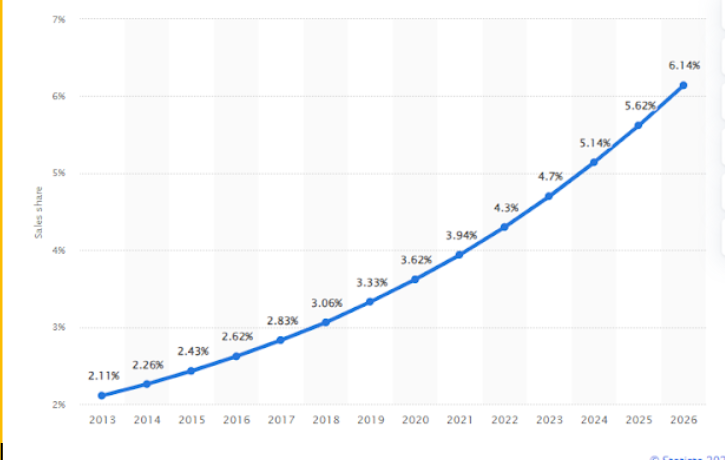 As per Statista, the projected growth in revenue share in sustainable clothing from 2013 to 2026. If you measure "worth" by access to an unparalleled network, world-class faculty, and a curriculum that is constantly updated to reflect the 2026 climate reality, the answer is a resounding yes. Oxford graduates don't just find jobs; they create systemic change. You’ll study alongside peers from 15+ nationalities, providing a truly global perspective. You learn from the experts who are literally writing the global policies. The "Oxford brand" acts as a powerful door-opener. In a competitive market, having a degree from the world's top-ranked geography school provides the institutional credibility needed to lead major transitions. Found it interesting? Did you know the University of Oxford also offers a popular Master’s- MSc in Sustainable Urban Development and hosts a 5-day programme in Oxford Sustainable Business! If a career in sustainability consulting, sustainable finance or Greentech, we urge you to check out these. Looking for other sustainability programs? You can check these out-
- MSc in Sustainable Urban Development (also offered by Oxford)
- Master of Science programs in Sustainability Management and Sustainability Science(offered by Columbia University)
- Duke University's Master's in Business, Climate, and Sustainability (MBCS)
- MSc in Environmental Studies and Sustainability Science (Offered by Lund University)
And more!
The transition to a sustainable economy is the greatest economic shift of our century. If you wish to be more than a spectator, a specialised master's might be your next best step. Ready to take the next steps? Get on a call with us and let’s discuss your next steps!
